Do you want to build more strength and muscle mass in your chest, shoulders, and triceps? Then the bench press is an essential part of your training schedule. This popular compound exercise is not only effective, but also an excellent way to measure your progress. In this blog, you will discover what the bench press is exactly, what it trains, how to perform it correctly, what variations there are, and why you should definitely try the exercise at ProFit Gym.
What is a bench press?
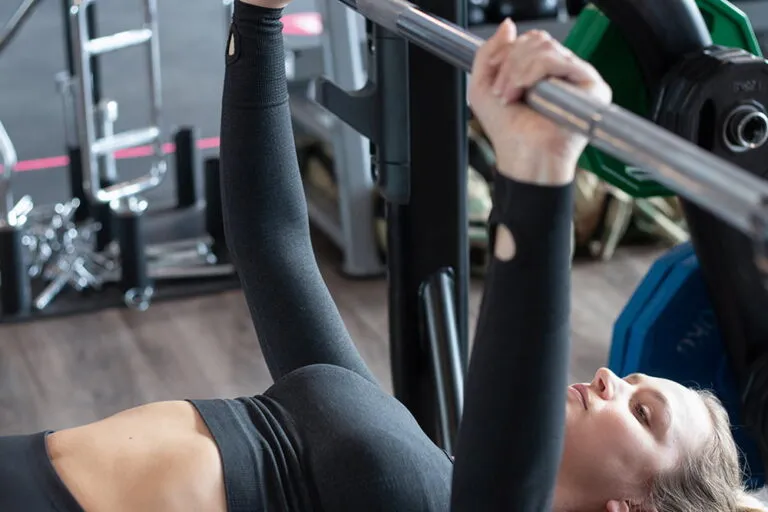
The bench press is a classic strength exercise in which you lie on a bench and lower a barbell or dumbbells to your chest and then press them back up. It is one of the most commonly used exercises in strength training and bodybuilding.
The movement seems simple, but it requires technique, control, and stability. You can perform the exercise with different types of weights and benches, depending on your goal: strength, muscle mass, or explosiveness.
What does the bench press train?
The bench press is a compound exercise, which means that it works multiple muscle groups at the same time. These muscle groups are:
- Pectoralis major (chest muscles): the main muscle that you develop with this exercise.
- Triceps: these extend your elbows as you push the weight up.
- Anterior deltoid: supports the movement and stabilization of the shoulder.
- Core and stabilizers: provide balance while pressing, especially with heavier weights.
Because you train so many muscle groups at once, the bench press is ideal for both strength building and muscle growth in your upper body.
How do you perform a bench press?
Proper technique is essential for effectively training your chest muscles and preventing injuries. Follow these steps:
- Lie down on the bench with your eyes directly under the bar. Place your feet firmly on the floor.
- Engage your core and pull your shoulder blades slightly toward each other. This stabilizes your upper back.
- Grasp the bar with a grip slightly wider than shoulder width. Keep your wrists straight above your elbows.
- Lift the bar off the rack and bring it straight above your chest.
- Lower the bar in a controlled manner to just above your sternum, elbows slightly angled outwards.
- Push the bar back up in a straight line. Exhale during this phase.
Additional tips:
- Always maintain control of the weight.
- Do not let the bar bounce on your chest.
- Use a spotter for heavier sets or if you are just starting out.
Different variations of the bench press
To train different parts of your chest and arms, you can vary the bench press. Here are the most commonly used variations:
1. Flat bench press
The standard version that works your chest, shoulders, and triceps at the same time.
2. Incline bench press
You lie at an upward angle (usually 30–45 degrees). This variation focuses more on the upper part of your chest.
3. Decline bench press
The bench is slightly angled downward, shifting the focus to the lower part of the chest.
4. Dumbbell bench press
Instead of a barbell, you use separate dumbbells, which requires extra stabilization and freedom of movement.
5. Close-grip bench press
With a narrower grip, you place more emphasis on your triceps.
By combining these variations wisely, you can develop your upper body completely and prevent your progress from stagnating.
Come work out at ProFit Gym
At ProFit Gym, we have everything you need for an effective and safe bench press. Our benches are high quality and equipped with adjustable racks. What’s more, our certified trainers are on hand to check your technique and make adjustments where necessary.
Whether you’re working on strength, muscle mass, or technique, we ensure that you can train with confidence. And that really makes a difference.
Want to know how to best combine the bench press with other exercises? Read our blog about compound exercises for beginners, or discover how to optimize your weekly schedule with push/pull splits.